Why Do People Not Want Art Classes in Schools
In these times, when the demolition of a place as historic as Sesame Street can be thwarted by editing for shorter attending spans and conversion to pay-per-view, it can be hard to remember what all the fuss was about during the peak of the Civilisation Wars. In these times, information technology'south piece of cake to presume that the growing absence of the arts and play in schools is i of time pressures and competing priorities and disagreements almost how children learn, and unrelated to a struggle for cultural control. Arts programs are being stripped from schools, especially schools serving our about vulnerable neighborhoods, because those schools are choosing, in response to a diverseness of policy decisions, to spend more fourth dimension on subjects more probable to raise scores on standardized tests.
Considering we've got to concern ourselves with a Common Core, right? Surely it is in anybody's all-time interest to focus on that?
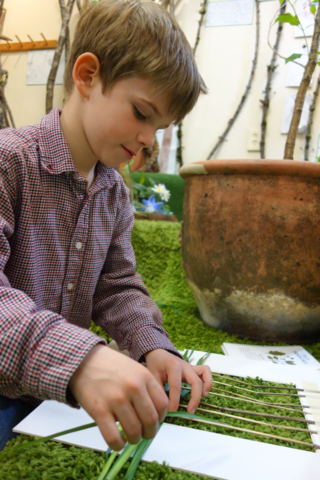
Regardless of the answer to those questions, what must be clear is that we are in the midst of a brutal fight to control the story that frames the world we live in equally American citizens. As any policy maker or political candidate knows, who controls the civilization controls the story. At that place is no amend way — actually, no otherway — to command culture, than to control access to the arts.
In their Culture of Inventiveness study, the LEGO Foundation synthesizes the work of 18 essayists from around the world, commissioned to write nearly creativity informed by the perspective of their own civilization. In summary, they write, "Civilisation is … a system through which people build meanings, and develop community, through the dimensions of having, doing, being and knowing. These are driven by playing, sharing, making and thinking — the agile processes through which people learn and form meanings together."
What is eliminated from our classrooms when we eliminate the arts is playing, sharing, making and thinking.
What is alienated from our classrooms is the opportunity to practise playing, sharing, making and thinking — without which it becomes impossible (or very difficult) to make meaning of our experience with the earth. Without practice in the arts, we take less power to reflect on our experience, to ask practiced questions, to express our perspective, to act on our feelings, to develop a community that might resist the status quo. If you can control the culture, you can control the story. And equally long as your version is correct, so alternatives tin can be, simply, wrong.
Restricting access to the arts allows those who wish to command the story to ensure that they are right and others are wrong. This feeling of beingness right empowers them to require obedience and sanctions a variety of punishments for disobedience — from expulsion in preschool to memory in second grade to defunding schools who don't pass tests to execution in the street in broad daylight. Fear of being wrong keeps people focused on being right instead of asking what'due south correct.
Fear decreases collaboration, listening, and ultimately, snuffs out empathy. Fearful people will autumn in line behind a dictator.
Restricting admission to the arts enforces silence by criminalizing creative disobedience. Increasingly, restricted access to the arts has grown an adult cohort that tolerates poisoned drinking water when a governor is responsible but calls other such violence, even when there are far fewer victims, an act of terror if ISIS is involved. Restricting the practice of playing, making, sharing, and thinking during the time when our youngest citizens' brains are growing has created a social club of adults that cannot tolerate ambivalence, cannot think critically, are fearful, and are drawn to radical political rhetoric.
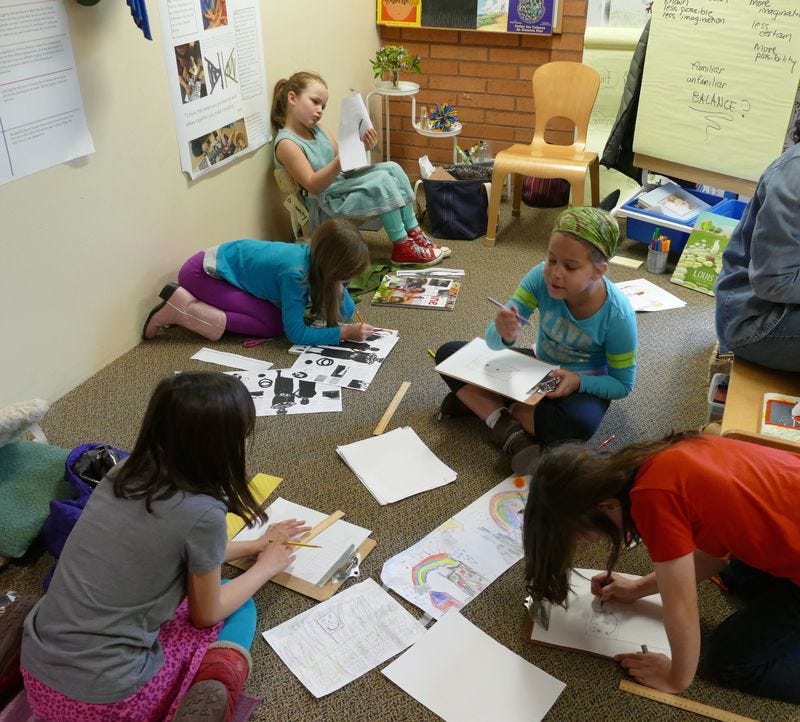
And so, these days, I wonder if the problem of the arts in schools is because of the human relationship between the arts and learning. Since the Reagan administration created policies that led to large decreases in funding to the National Endowment for the Arts every bit belatedly every bit 1997, the year in which the civil-rights-inspired Expansion Arts Programme was discontinued, the result has been that fewer artists are against bug that challenge the status quo. Fewer people are playing, sharing, making and thinking.
Dudley Cocke of Roadside Theater writes, "Most problematically, without federal support national conversations almost culture policy began to evaporate, and in the void nonprofits hunkered down to fight for their ain." In our public schools and in our non-profit organizations, fewer people are playing, sharing, making and thinking. And that ways that fewer people are contributing to the development of what we experience as American culture.
Schools without fine art hateful that fewer children discover the power of their own potential for expression.
And that ways that over time fewer voices are contributing considering fewer people believe that they have something to contribute. Fewer people believe they take a correct or a reason to contribute. And as creative capacity is diminished, commercialism eagerly fills the void.
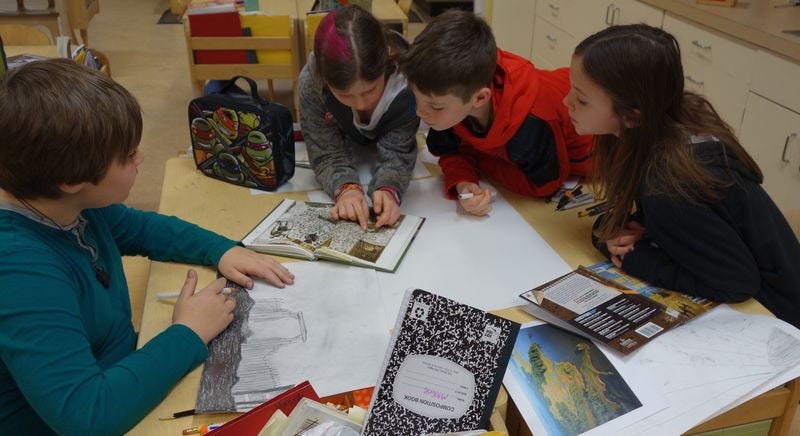
From Disney to McDonald's to Sponge Bob to Big Bird, commercial civilization has increasingly replaced or been confused with creativity. And while their children are delighted, adults are distracted from the problem at hand.
Commercial civilisation has led adults, for example, to focus on how the arts tin can be leveraged for other tasks — like how music improves math — rather than on the cultural bear upon of cutting the arts from our environments for learning. In his commodity Art and Democracy, Cocke writes, "the impact of U.S. commercial civilisation in this moment of globalization has become overwhelming. Imagine how the U.Southward. looks to hundreds of millions of people around the world whose but sources of information about us are commercial or propaganda television, Hollywood movies, and popular music. Equally troubling, at home this commercial preference has corrupted our own not-for-turn a profit sectors' core values." It has been more than a decade since this article was published, and we tin can encounter the the affect. Commercial culture has functioned every bit a sleight of manus, obscuring the distinction betwixt creator and consumer, seducing u.s. into an acceptance of conformity and loss of identity, and handing us the politics of the day.
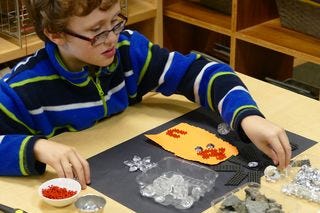
One part of the NEA's original purpose statement reads, "Democracy demands wisdom and vision in its citizens and must therefore foster and back up a form of teaching designed to make men masters of their technology and not its unthinking servant." As funding for the arts has been cut, these ideas have been diluted. As economic disparities have grown, artistic disparities have grown alongside them. When the children of parents who can pay $38,000 a year for preschool are told by school founder Chris Wink, "This much is certain: it volition exist impossible to convince [our] children that their aspirations are unattainable. …At that place will be no mode of fooling them into believing that the stirrings in their hearts are unimportant." And David Coleman, the architect of Common Core, is telling the children downwards the street at the neighborhood public school that "people don't actually give a **** virtually what yous feel or what you think", it's long past time to consider the implications of such a serious threat to our commonwealth. The question remains: what are we willing to do about it? How volition we notice our way?
The authors of the LEGO Foundation's Civilisation of Creativity report write, "cultures are fabricated by humans, just civilization too significantly shapes young children, because the man race is amazingly adaptive, especially in the disquisitional young years." It is precisely considering the young homo is so amazingly adaptive that finding ways to infuse the arts into the daily life of the classroom may exist the greatest subversive tool we take to combat the commercialized, controlled, and combative civilization that will otherwise shape our children. Playing, making, sharing, and thinking are the birthright of our species and natural learning strategies that all children bring with them to school. Children go far at schoolhouse with a creative mindset. What experiences and environments can adults design to sustain and extend information technology?
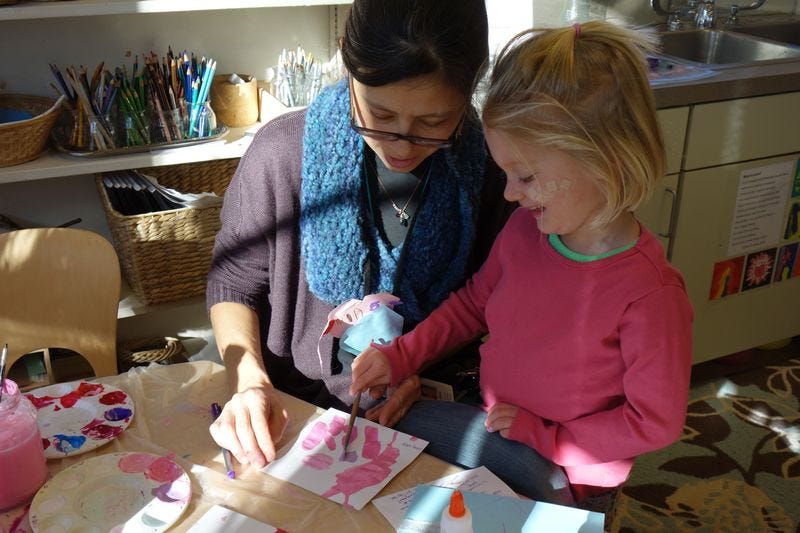
I don't consider myself to exist an artist, or an art teacher. Yet, when I am teaching in the classroom, it is my habit to ask myself, "Where are the arts?" I discover that when I habitually inquire that question equally I'1000 planning, the arts become habitual. The availability of tools of the arts, as well equally an invitation to employ them, secures my role equally "professional marveller" as Loris Malaguzzi, founder of the municipal preprimary schools in Reggio Emilia, Italy, fondly described the work of the instructor. Similar the day several weeks ago, when 8 year-old Ella wondered aloud during a whole grouping dialogue in response to a volume I'd read to them, "I know that metacognition means thinking about your thinking. But what's the word that means thinking well-nigh your feelings?" The excited hush that typically follows such a beautiful question ran through the group. What is that word? And how might those words be related? How are thinking and feeling related? Which comes first? Can you lot have one without the other?
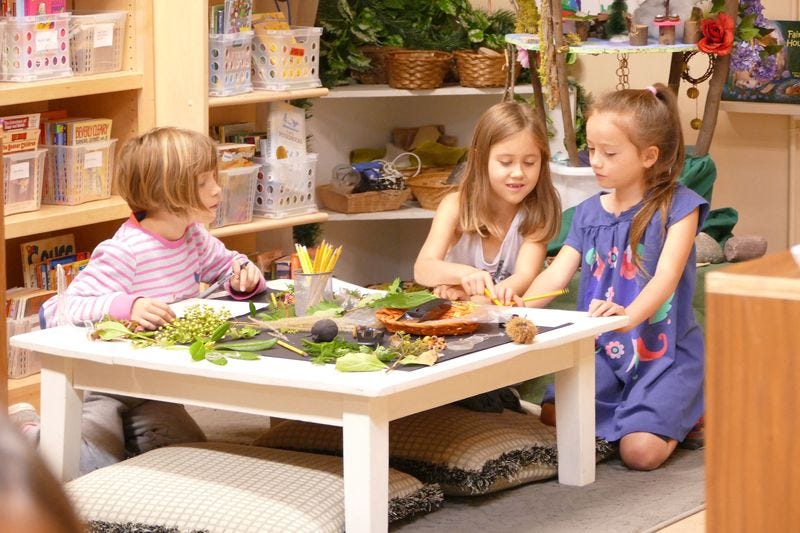
And then I invited the children to PLAY with the idea. Using collections of loose function materials for collage or building, I invited them to Brand a theory and to SHARE it with a partner. And information technology wasn't also long before 8 twelvemonth-old KD ran excitedly to me and said she'd been just fiddling around with a shiny piece of tinsel in the light when she fabricated a discovery. She explained, "It all started out with a shiny piece. Its shadow reflected on the table. Like in Buddy and Earl,[Buddy] thought about his feelings and he felt his feelings of beingness friends. You lot think nigh your thinking and you feel and yous experience and you retrieve — it goes back and forth like the reflection in a mirror. Information technology'south reflection!"
I don't demand to exist an artist to offer children apply of the materials of the arts as tools for thinking. And that'southward not to diminish the value of artists in the schools or children'due south encounters with artists who tin can teach and apprentice them, offering inspiration and skill and technique that they have a right to just as much as they have the right to multiplication tables or cyberspace enquiry. Information technology's just to say that I tin can choose to keep the door open. And when I do, they retain access to their creative birthright. They practise influencing the culture of their classroom community with their ideas and feelings and questions and contributions. They find out they can.
More of the NEA'south purpose argument reads, "The do of fine art and the written report of the humanities require constant dedication and devotion and . . . it is necessary and appropriate for the Federal Government to assist create and sustain not only a climate encouraging freedom of thought, imagination, and research, but likewise the material conditions facilitating the release of this artistic talent." We are now reaping the results of a dedication and devotion to commercialism and consumerism.
If we are to evolve across a culture that confuses adolescent posturing with political debate, nosotros'll demand to offer our youngest citizens a climate encouraging freedom of thought, imagination and enquiry. We'll need to grow a new kind of citizenry. And that means nosotros'll need to invest in the material conditions that will facilitate the release of every child's inherent creative talent. Because it is simply when our youngest citizens practice knowing how to limited such freedoms in the company of others who accept the right to do the same, that our civilisation will evolve to one that can tolerate the uncertainty inherent in diversity — a civilisation that is mettlesome nigh addressing the problems that come with trying to thrive equally an individual in the midst of a thriving, vibrant and loving society — the one that we made together.
Bio: Susan Harris MacKay'southward work first appeared on the Living in Dialogue blogand the appeared on the Opal Schoolhouse Blog.
johnsonwisecon1936.blogspot.com
Source: https://www.ashoka.org/en/story/why-we-don%E2%80%99t-do-art-school-and-why-we-should
0 Response to "Why Do People Not Want Art Classes in Schools"
Postar um comentário